You spot a dark patch on the wall, and your hand goes straight to the bleach under the sink. Totally natural. Bleach smells like “clean,” it whitens stains, and it’s right there.
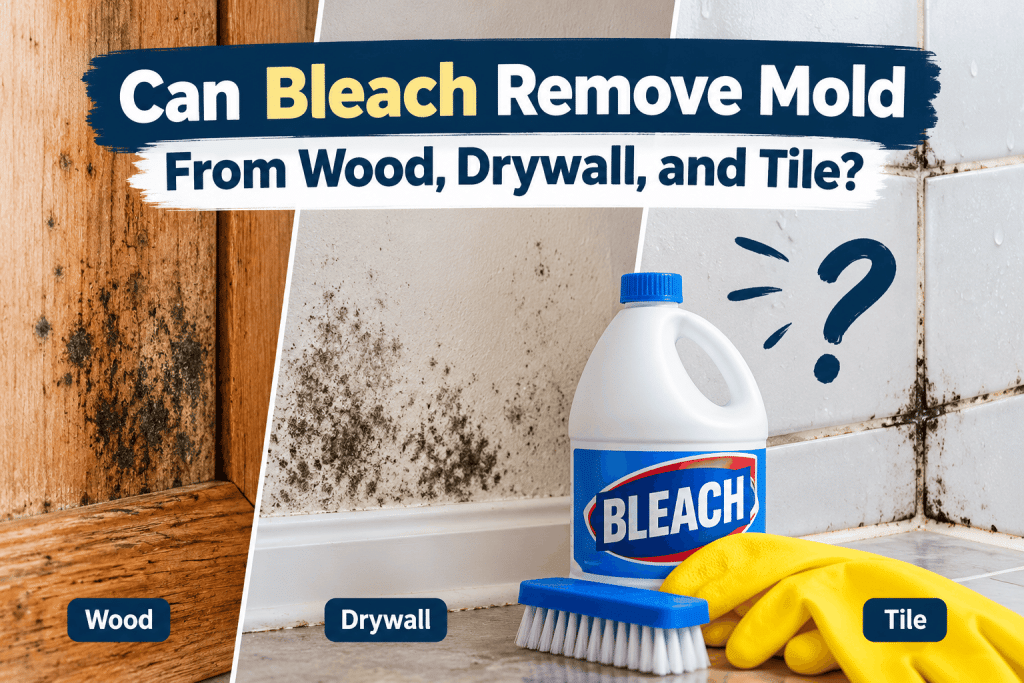
But here’s the awkward truth: whether bleach mold removal works depends almost entirely on what’s growing it. Tile, drywall, and wood behave very differently. Here’s how each one plays out.
The Short Answer
Bleach can lighten and clean the surface of hard, non-porous materials. On porous ones, it usually can’t reach the growth underneath. The EPA doesn’t recommend routine bleach use for mold, and it stresses that killing mold isn’t enough, because dead mold can still cause allergic reactions. What counts is removing the growth and fixing the moisture behind it.
So the real answer is “sometimes, on certain surfaces, and rarely as a full fix.”
Why Bleach Struggles on Porous Surfaces
Mold doesn’t just sit on top. On porous materials, it sends tiny root-like threads (hyphae) into the surface. Bleach tends to stay near the top, while much of its water content can soak in, which may actually leave damp material for mold to feed on later.
That’s why bleach mold removal on porous materials often looks great for a week and fails by the next. The stain fades, but the growth stays.
Surface by Surface
Tile and Glass: Mostly Yes
Glazed tile, glass, and bathtubs are non-porous, so surface cleaning works well. Bleach mold removal on tile can clear what you see on the surface.
The catch is grout, which is porous. Mold in grout lines often returns because the growth sits deeper than the surface. If grout is crumbling or stays damp, the problem may be water getting behind the tile.
Drywall: Usually No
Drywall is basically paper-covered gypsum, and paper is mold food. Bleach won’t penetrate the growth, and spraying it adds moisture to a material that’s already wet.
If mold covers a large area, drywall feels soft or stained, or there’s a musty smell without visible growth, the safest route is usually removing and replacing the affected section after fixing the leak.
Wood: Depends
- Surface mold on sealed or finished wood: Often cleaned with detergent and water, then dried thoroughly.
- Mold on raw or unfinished wood: Tougher, because the grain absorbs moisture and growth.
- Structural wood like joists and framing: Best left to professionals, since damage and spread matter.
Bleach mold removal on wood tends to bleach the color without solving the root issue.
What Works Better Than Bleach
For small surface patches on hard materials, the EPA suggests scrubbing with detergent and water, then drying completely. The scrubbing physically removes the mold, which is the point. If you do reach for bleach, you’re adding a step, not replacing the work.
And the biggest part of the job has nothing to do with cleaning: find and fix the moisture source. Without that, any method is temporary. If your mold keeps reappearing, check out our guide on why mold keeps coming back.
If You Still Use Bleach, Do It Safely
Some homeowners use it on tile or tubs anyway, and that’s fine if you take precautions:
- Ventilate: Open windows and run fans
- Protect yourself: Wear gloves, goggles, and a properly fitted mask
- Dilute it: The CDC suggests no more than one cup of bleach per gallon of water
- Never mix: Don’t combine bleach with ammonia or other cleaners, since it can create toxic gas
- Dry the area: Leftover moisture invites regrowth
Bleach mold removal also shouldn’t be attempted by anyone with asthma, allergies, or a weakened immune system. Let someone else handle it.
Myths Worth Retiring
- “If it’s white, it’s gone.” Fading doesn’t mean the growth is gone.
- “Black mold is the only dangerous kind.” You can’t judge mold type by color.
- “Stronger bleach works better.” More isn’t better, and it raises fume risks.
- “Painting over it fixes it.” Mold can grow right through paint.
When to Skip the DIY Route
The EPA suggests that patches larger than about 10 square feet are a job for a professional. Call for help sooner if:
- Mold keeps returning after cleaning
- Drywall is soft, bubbling, or stained
- The musty smell is strong but you can’t find the source
- Water damage or a flood caused it
- It’s near HVAC ducts or inside walls
- Someone in the home has health sensitivities
At that stage, bleach mold removal is just a bandage. Mold removal services in Los Angeles can inspect the source, contain the area, and remove the damaged material safely.
What Professional Help Involves
A typical process follows three steps: assessment to find the moisture source, mitigation using containment and drying, and restoration to rebuild what was removed. Los Angeles homes often add complications like windowless bathrooms, older plumbing, and coastal humidity, so local mold removal services in Los Angeles understand where hidden moisture tends to hide.
What Not to Do Before Calling
- Don’t scrub or spray a large patch, since disturbing it can spread spores
- Don’t run fans toward it
- Don’t cut into walls on your own
- Do take photos, note when you first noticed it, and keep the area dry
Skip the Guessing Game
If you’ve been cycling through bleach bottles and the stain keeps coming back, the wall is trying to tell you something. Bring that story to 247 Pro Restoration. Their team can inspect the area, trace the moisture behind it, and walk you through a plan, with mold removal services in Los Angeles that treat the cause, not just the stain. Your bleach mold removal days can end where the real fix begins.