Seeing mold on a bathroom wall, around a window, or under a sink can make any Los Angeles homeowner reach for a cleaning bottle. An anti-mold spray seems like the obvious answer: spray it on, wipe the area down, and move on.
But does it actually solve the problem?
The short answer is: sometimes, but not always.
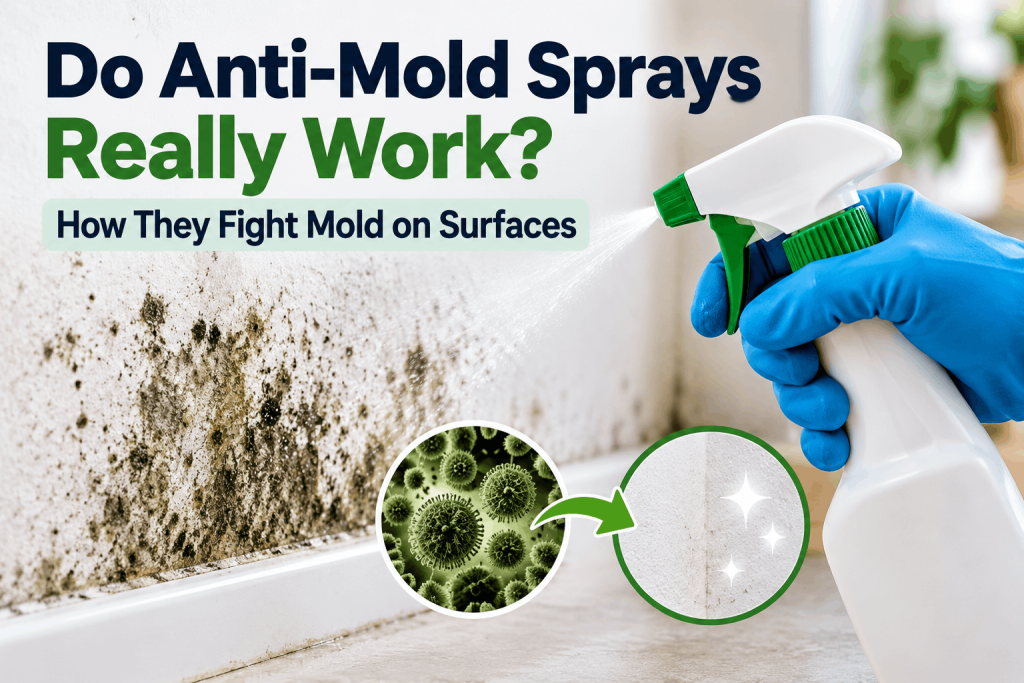
An anti-mold spray can be useful for treating limited mold growth on suitable hard, non-porous surfaces. However, mold is not simply a stain that can be sprayed away. If moisture remains behind the surface, or mold has penetrated porous materials, surface cleaning alone may not be enough.
That distinction matters when considering mold removal in Los Angeles, where a leak, condensation, plumbing issue, or water-damaged material can create the conditions mold needs to keep coming back.
What Does an Anti-Mold Spray Actually Do?
Most mold-control sprays are designed to either kill or inhibit mold on the surface, loosen mold and mildew so it can be cleaned away, or disinfect the treated area.
The chemistry varies from product to product. Some contain bleach or other antimicrobial ingredients, while others use different cleaning agents. The label matters, because products differ in the surfaces they are designed for and the contact time required.
An anti-mold spray may therefore help with visible growth on surfaces such as tile, glass, or certain sealed materials. But killing mold and removing mold are not necessarily the same thing.
The EPA specifically notes that dead mold can still trigger allergic reactions in some people. Simply killing mold without physically removing the contamination does not necessarily complete the cleanup.
Where Sprays Can Be Useful
For a small, isolated patch on a hard surface, an anti-mold spray can be a practical part of routine cleaning.
Think of areas such as:
- Bathroom tile and grout
- Glass shower doors
- Certain sealed countertops
- Small areas of surface mold on other non-porous materials
The key is the surface itself. EPA guidance recommends scrubbing mold from hard surfaces with detergent and water and then drying them completely.
If you’re searching for mold removal because you noticed a small patch in a bathroom, it is worth first determining whether you’re dealing with a surface issue or a larger moisture problem.
Why Spraying Mold Isn’t the Whole Job
Here is where many homeowners get caught off guard.
Mold needs moisture. If a plumbing leak, roof leak, condensation problem, or persistent humidity is still present, cleaning the visible growth does not remove the reason it developed in the first place.
That is why an anti-mold spray can produce a temporary improvement while the underlying problem continues.
Porous materials create another challenge. Materials such as drywall, carpet, insulation, and ceiling tiles can absorb moisture and allow mold to grow within their structure. EPA guidance notes that mold can be difficult or impossible to completely remove from some porous materials.
In those situations, mold removal in Los Angeles may involve much more than wiping down a discolored patch.
The Difference Between Killing Mold and Removing It
This is an important distinction homeowners often miss.
A product may kill mold organisms on a surface, but the residue, spores, and damaged material can still remain. That is why simply spraying an area and walking away isn’t necessarily sufficient.
If a product claims that it actually kills mold and mildew, check what the product is registered or labeled to do, follow its directions carefully, and understand that killing organisms is not the same as completing remediation.
The EPA does not recommend routine use of biocides such as chlorine bleach as a standard mold-cleanup practice. Its guidance emphasizes physical cleaning and, most importantly, correcting the moisture source.
When a Spray May Not Be Enough
A homeowner should take the situation more seriously when:
The mold keeps returning
If you clean the same area repeatedly and the mold comes back, there may be an ongoing moisture source that needs attention.
The affected material is porous
Mold inside drywall, insulation, carpeting, or similar materials may require removal or replacement rather than surface treatment.
There has been significant water damage
Flooding, a burst pipe, roof leak, or prolonged water intrusion can create conditions for broader contamination.
You smell mold but cannot find it
A persistent musty odor without an obvious source can sometimes point toward hidden moisture or mold behind walls, under flooring, or in other inaccessible areas.
These are situations where professional mold removal services can be more appropriate than repeatedly treating visible spots yourself.
What Professional Mold Removal Looks Like
Professional mold removal services are not simply about applying a stronger chemical.
The process should begin by identifying the extent of the problem and looking for the moisture source. From there, the appropriate containment, removal, drying, cleaning, and restoration steps depend on the property and materials involved.
That approach is consistent with the basic principle emphasized by the EPA: moisture control is the key to mold control.
24/7 Pro Restoration describes its restoration process around assessment, mitigation, and restoration. The company serves Los Angeles County and Ventura County and offers mold treatment alongside water-damage restoration and other property restoration services.
For homeowners considering mold removal in Los Angeles, that broader restoration capability can matter when mold is connected to water damage rather than being an isolated surface stain.
So, Do Anti-Mold Sprays Really Work?
Yes—but their usefulness depends heavily on the situation.
An anti-mold spray can help clean limited surface growth on appropriate hard surfaces. It can be useful as part of regular household maintenance when the affected area is small and the underlying moisture issue has been addressed.
What it cannot reliably do is solve every mold problem in a home.
If mold has spread into porous materials, keeps returning, is associated with significant water damage, or appears to be coming from somewhere hidden, spraying the visible area may only address the symptom.
That is when mold removal services become worth considering, particularly if you want the source and extent of the problem properly assessed rather than repeatedly treating the same spot.
When It’s Time to Bring in 24/7 Pro Restoration
A little surface mold does not always mean your home needs a major restoration project. But persistent growth, recurring moisture, water damage, or suspected hidden mold deserves a closer look.
24/7 Pro Restoration provides 24/7 emergency restoration response across Los Angeles County and Ventura County, with mold treatment, water removal, advanced equipment, and an experienced restoration team.
If you’re facing a mold problem that keeps coming back or goes beyond a simple surface cleanup, mold removal in Los Angeles should focus on more than making the stain disappear. It should address the moisture, affected materials, and conditions allowing the mold to return.
For homeowners who need professional mold removal in Los Angeles, 24/7 Pro Restoration can assess the situation and help determine the appropriate next step. Call 888-439-3620 to discuss your property and request assistance.