Finding mold in your Los Angeles home can trigger an immediate question: What should I use to get rid of it? Walk through any home improvement aisle or search online, and you’ll find plenty of cleaners promising to tackle mold. But not every product is appropriate for every surface, and removing visible growth is only one part of solving a mold problem.
The best mold removal product is not necessarily the strongest chemical you can find. It needs to be appropriate for the surface, used according to its label, and paired with the most important part of mold control: addressing the moisture that allowed the mold to grow in the first place. The EPA specifically identifies moisture control as the key to controlling mold.
So, what actually works, what should you avoid, and when is a DIY approach no longer enough?
Start With the Surface, Not the Product
Before reaching for a cleaner, look at where the mold is growing.
Hard, non-porous surfaces
Tile, glass, metal, and some hard plastics can generally be cleaned by scrubbing with water and detergent, followed by thorough drying. The EPA recommends this basic approach for mold on hard surfaces.
For a small patch on a bathroom tile or similar surface, a properly labeled household mold cleaner may be useful. The best mold removal product for this type of job is one you can safely use on that particular surface and according to its directions—not simply the one with the most aggressive-sounding claims.
Porous materials are different
Drywall, carpet, ceiling tiles, insulation, and other absorbent materials can present a much bigger challenge. Mold can penetrate spaces within these materials, making complete cleaning difficult or sometimes impossible.
That is where simply spraying the visible area can create a false sense of progress.
Which Mold Removal Products Can Help?
There is no universal product that works equally well everywhere. The right choice depends on the material, the extent of contamination, and whether the moisture source has been corrected.
Detergent and water
Sometimes the simplest approach is the appropriate one. For mold on suitable hard surfaces, detergent and water can physically remove visible growth when followed by complete drying.
This is important because mold cleanup is not simply about killing organisms with a chemical. The EPA notes that dead mold can still cause allergic reactions, meaning physical removal matters too.
Disinfecting or antimicrobial products
Some situations may call for an appropriate disinfectant or antimicrobial treatment, but these should not be viewed as a substitute for cleaning and moisture control.
If you’re researching mold removal products in Los Angeles, read the label carefully. Check what surfaces the product is intended for, required contact time, ventilation requirements, protective equipment, and any warnings about mixing it with other cleaners.
For general guidance on household surfaces, resources explaining that this kills mold and mildew on household surfaces can be useful, but always compare that information with the product’s own label instructions and the specific material you’re treating.
Products That Can Create More Problems
More chemical power does not automatically mean better mold removal.
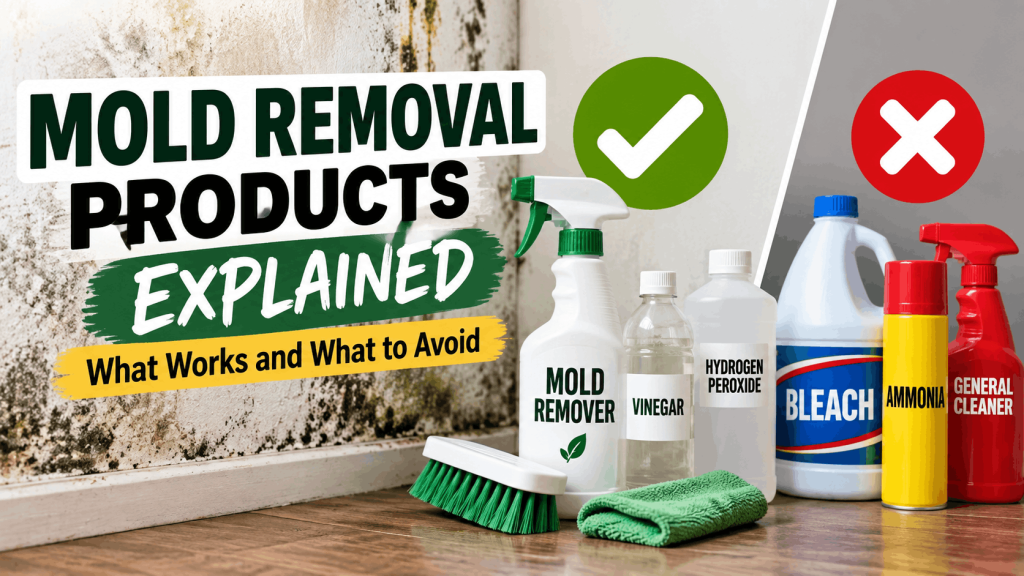
Bleach isn’t a universal mold solution
Bleach is commonly associated with mold cleanup, but the EPA does not recommend chlorine bleach as a routine practice for mold remediation. It also emphasizes that simply killing mold isn’t enough, the remaining material still needs to be removed.
The CDC does provide circumstances in which bleach can be used for household mold cleanup, particularly on appropriate hard surfaces, but stresses following safety directions and never mixing bleach with ammonia or other cleaners.
So, if you’re comparing mold removal products in Los Angeles, don’t automatically assume bleach is the strongest or smartest answer.
Avoid mixing cleaning chemicals
This deserves its own warning.
Never combine bleach with ammonia or other cleaning products. Toxic gases can result. The CDC specifically warns against mixing bleach with ammonia or other cleaners.
Using several products together because one product “didn’t seem strong enough” is not a shortcut worth taking.
Don’t paint over mold
Painting over a moldy surface may hide the discoloration temporarily, but it doesn’t address the underlying contamination or moisture problem. The EPA advises cleaning and drying moldy surfaces before painting because paint applied over mold is likely to peel.
In other words, paint is not a mold-removal product.
Why Mold Keeps Coming Back After Cleaning
You’ve scrubbed the wall. It looks better. A few weeks later, those familiar spots return.
Sound familiar?
The problem may not be the cleaner at all.
A plumbing leak, roof issue, condensation, excess indoor humidity, or previous water damage can continue supplying the moisture mold needs. The EPA’s guidance is straightforward: fix water problems and dry materials completely.
This is why searching for mold removal products in Los Angeles should be only the beginning of your research. A product may clean what you can see while leaving the reason for the growth untouched.
When DIY Cleanup Makes Sense, and When It Doesn’t
For a small area of mold on a suitable hard surface, careful household cleanup may be reasonable. The EPA generally considers areas smaller than about 10 square feet suitable for many homeowners to handle themselves, provided the situation doesn’t involve complicating factors such as extensive water damage or contaminated water.
A professional assessment becomes more important when:
- Mold covers a larger area.
- Mold keeps returning after cleaning.
- Drywall, insulation, carpeting, or other porous materials are affected.
- There has been significant water damage.
- You suspect mold is hidden inside walls or other inaccessible areas.
- Your HVAC system may be contaminated.
- Sewage or contaminated water was involved.
The EPA specifically recommends professional help for larger mold problems, significant water damage, suspected HVAC contamination, and contaminated-water situations.
What Professional Mold Removal Adds
A mold removal company in LA can look beyond the visible patch and consider the broader condition of the property.
That can include identifying the extent of the damage, determining which materials can be cleaned, addressing moisture-related issues, containing affected areas, and using appropriate restoration equipment and procedures.
This matters because mold remediation isn’t simply a matter of finding a stronger spray.
24/7 Pro Restoration describes its process around assessment, mitigation, and restoration. The company provides mold removal alongside water damage restoration and other property restoration services, with 24/7 emergency response across Los Angeles County and Ventura County.
If you are comparing a mold removal company in LA, look for more than a promise to “kill mold.” Ask how the company approaches moisture, affected materials, containment, cleanup, and restoration.
A Practical Way to Choose a Mold Product
Before buying anything, ask yourself five questions:
- What material is affected?
- How large is the affected area?
- Has the moisture source been fixed?
- Can I safely clean this without spreading contamination?
- Could the mold be inside a porous material or hidden area?
If you are looking through mold removal products in Los Angeles, these questions can prevent you from choosing a product simply because it has impressive wording on the bottle.
And if you’re researching whether anti-mold sprays work really well, the honest answer is: they can be useful for appropriate surface-level applications, but they aren’t a replacement for proper cleanup, drying, and addressing the source of moisture.
Get the Mold Problem Assessed, Not Just Covered Up
Choosing the best mold removal product starts with understanding that no single product is right for every situation. A cleaner may be perfectly reasonable for a small amount of surface mold, while porous materials, hidden growth, extensive contamination, or water damage can require a completely different response.
If you’ve tried cleaning and the mold keeps returning, or you’re dealing with more than a small surface patch, 247 Pro Restoration can help assess the situation and determine the appropriate restoration approach. Their team provides mold removal and restoration services throughout Los Angeles County, with 24/7 emergency response when property damage can’t wait.
Rather than spending money cycling through one product after another, get a clearer picture of what’s causing the problem and what needs to be done. 24/7 Pro Restoration is there to help Los Angeles homeowners move from visible mold and uncertainty toward a properly assessed restoration plan.